
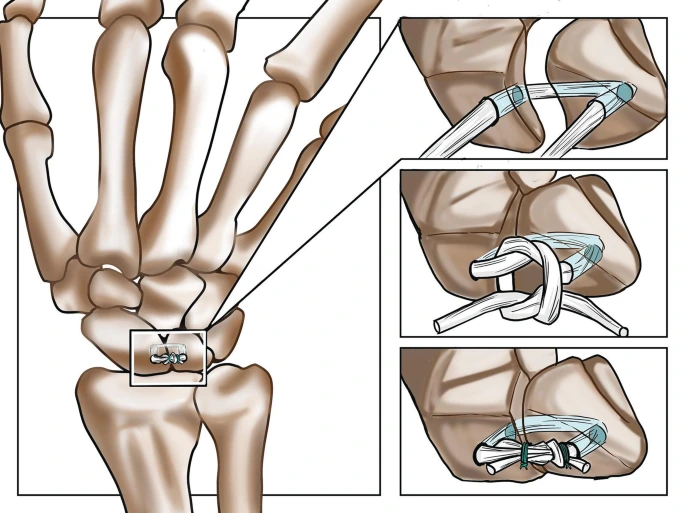
The scapholunate ligament plays a crucial role in maintaining the stability of the wrist joint, particularly between the scaphoid and lunate bones. Injuries or tears to this ligament, often caused by trauma or repetitive strain, can lead to pain, weakness, and instability in the wrist. Scapholunate ligament repair and reconstruction are surgical procedures designed to restore stability and function to the wrist, reduce pain, and prevent long-term complications such as arthritis.
In cases where the scapholunate ligament is partially torn or stretched, a repair may be performed to reattach the ligament to the bone. This procedure typically involves suturing the torn ligament back into place to restore its normal function and stability.
For more severe cases, where the ligament is completely torn or there is significant damage, reconstruction may be necessary. In this procedure, the damaged ligament is replaced with either a tendon from the patient’s own body or a donor tendon to restore the joint’s stability. The tendon is attached to the bones in a way that mimics the original ligament’s function, promoting stability and reducing pain.
These procedures are ideal for patients who have experienced wrist instability, pain, or weakness due to scapholunate ligament injuries, particularly when conservative treatments like physical therapy or splinting are no longer effective.
Recovery after scapholunate ligament repair or reconstruction typically involves:
If you are experiencing wrist pain or instability due to scapholunate ligament injury, contact us today to discuss how scapholunate ligament repair or reconstruction can restore your wrist function and improve your quality of life.

Expert in trauma care, sports medicine, joint replacement, and deformity correction, delivering advanced orthopedic solutions with precision and care.
Copyright @ 2024. All rights reserved. Designed by AppAdd India Pvt Ltd…